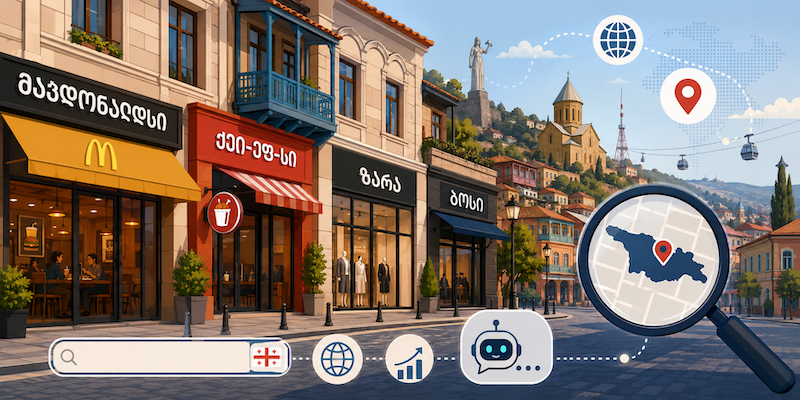
Walk through Tbilisi and you will quickly notice that global brands do not always look exactly the same in Georgian.
McDonald’s becomes მაკდონალდსი.
Dunkin’ Donuts becomes დანკინ დონატსი.
KFC appears as ქეი-ეფ-სი.
BOSS becomes ბოსი.
Carrefour becomes კარფური.
The brands are still recognizable. The logos, colors, and storefront design remain familiar. But the written names have been adapted to work in Georgian.
This is localization in practice.
For companies entering Georgia, localization is not only about translating a website or brochure. It affects how a brand is pronounced, displayed, searched for, regulated, and remembered.
A brand name is rarely translated word for word. More often, it is adapted.
In Georgian, international brand names are usually written according to pronunciation rather than English spelling. The goal is not to reproduce every Latin letter mechanically. The goal is to create a Georgian version that local customers can read, say, and recognize.
That is why McDonald’s becomes მაკდონალდსი rather than a letter-by-letter copy of the English form. The Georgian version follows the sound of the name and adapts it to Georgian script and usage.
This is one reason professional Georgian translation and localization services matter. A brand name, product name, slogan, or campaign phrase may need more than direct translation. It may need linguistic judgment.
One common pattern in Georgian brand localization is the final ი.
Examples include:
This ending often helps a foreign name fit more naturally into Georgian pronunciation and grammar. It gives the borrowed name a form that Georgian speakers can use more easily in everyday speech.
This does not mean every foreign brand must end in ი. Brand owners, local marketing teams, legal requirements, pronunciation, visual identity, and customer habits all influence the final version.
That is why brand-name adaptation should not be treated as a minor detail. Once a localized name appears on signs, receipts, maps, packaging, social media, and search results, changing it later becomes difficult.
KFC is a useful example because it shows how acronyms work in localization.
In Georgian, KFC is commonly written as:
ქეი-ეფ-სი
This reflects the English pronunciation of the letters: “Kay-Ef-See.”
The Georgian version does not translate the meaning of the letters. It reproduces how the acronym is spoken. This approach is common for international abbreviations, especially when the brand is already known globally by its initials.
The same principle applies to many product names, company names, technical abbreviations, and institutional acronyms. The right solution depends on how the term is used by real people, not only on how it appears in the source language.
Not every brand creates a localization challenge.
ZARA becomes ზარა. The pronunciation transfers naturally into Georgian, so the adaptation is simple.
Other names require more work. Double consonants may disappear. Endings may be added. Sounds that do not exist in Georgian may need approximation. Acronyms may be written phonetically. In some cases, the Latin brand name may remain partly visible for international recognition.
This is where localization becomes a brand decision, not just a linguistic decision.
A company entering Georgia should ask:
These questions should be answered before launch, not after the brand is already visible in the market.
Brand localization is not limited to words. It also affects visual identity.
A Georgian version of a brand name must work on storefront signs, menus, websites, packaging, mobile apps, maps, invoices, and advertisements. The Georgian script has its own structure, rhythm, and proportions. A design that works well in Latin script may not automatically work in Georgian.
This is especially important for companies with strict brand guidelines. The localized name should feel local without weakening the global identity.
In practical terms, localization may involve typography, layout checks, DTP work, proofreading, and pre-print review. For printed or designed materials, DTP publishing services are often just as important as translation.
Physical signs are only part of the story. Customers also search online.
A person in Georgia may search for the same brand in several ways:
If a company only optimizes its website for English-language searches, it may miss local search demand.
This is where multilingual SEO becomes important. Proper localization should include Georgian keyword research, localized metadata, Georgian landing pages, Google Business Profile optimization, and consistent use of brand-name variants.
Being translated is not enough. A brand also needs to be discoverable.
For international companies, translation and localization services should connect linguistic accuracy with search visibility. Otherwise, the localized content may be correct but commercially weak.
Search behavior is changing. Customers increasingly ask AI tools questions instead of typing simple keywords into Google.
They may ask:
In these cases, users may receive direct answers instead of a traditional list of search results.
This creates a new visibility challenge. Companies need content that search engines and AI systems can understand clearly. Their names, services, locations, language versions, and market presence should be structured consistently across websites, business profiles, articles, and public references.
Generative Engine Optimization, or GEO, is still a developing field. But the principle is simple: clear, structured, localized content is easier for both search engines and AI systems to interpret.
For brands entering Georgia, multilingual SEO and AI-era content visibility should be considered together.
Poor localization can create practical problems.
A badly adapted brand name may confuse customers. Inconsistent spelling may weaken search visibility. Poor terminology may damage trust. Incorrect legal or medical translation may create compliance risk. Weak layout adaptation may make printed materials look unprofessional.
This is why localization should be treated as part of market-entry planning.
For regulated industries, the stakes are even higher. Legal, financial, medical, technical, and compliance-related content requires subject-matter knowledge, terminology control, and quality assurance. In these cases, localization is not only a marketing task. It is a risk-management process.
Companies should work with language partners that understand both the local market and the consequences of inaccurate communication. Caulingo’s work in language risk management, linguistic quality assurance, and specialized Georgian translation is designed for exactly this type of need.
A Georgian storefront sign may look simple. But behind it there may be several decisions:
This is why successful localization starts before the first campaign goes live.
Entering a new market is not just about translating words. It is about making sure your brand can be found, understood, trusted, and remembered.
Caulingo helps companies prepare for that process through Georgian localization, multilingual SEO, translation, transcreation, terminology management, DTP, MTPE, and language consulting.
If your company is entering Georgia or expanding across multilingual markets, start with the language decisions that customers will see first: your name, your message, and how people will find you.